The Anchorage Daily News story today about the life and times of Talkeetna bush pilot Cliff Hudson covers only part of what made Cliff Hudson irreplaceable.
As we enter the second decade of the 21st century enmeshed in the web of our cell phone devices and digital links to the virtual world, the passing of a man like Cliff Hudson is a reminder that at some point our lives are both enriched and dependent upon those quiet, self-possessed people who find their niche and live their lives just doing what they find needs to be done without hoopla or fanfare.
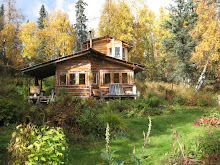
A mere 15 years ago, in the days when CB radios were the sole shaky link between the homestead and the outside, Judy's mom had a heart attack in Virginia. We received word within hours of the hospitalization through a phone call from a family member in Virginia to a Talkeetna friend who then contacted Hudson Air Service. Despite the fact that it was the busy Denali climbing season when every flyable moment is booked solid ferrying climbers on and off the mountain, an orange-painted Cessna piloted by Jay Hudson was soon circling above the cabin. We fired up the CB and received timely word of the family crisis. While today (assuming the cell towers are functioning) a digital message might be transmitted in seconds; in the real world it was always comforting to know that Cliff and Jay Hudson were out there flying cover for those of us who lives take us to the backwoods of Alaska.
Whether it was making a weekly mail run to Gold Creek or lending a helping hand to the down and out, Cliff Hudson always just did what needed to be done. He will be sorely missed.
Thursday, March 11, 2010


Wednesday, November 25, 2009
Public Citizen Reports on Alaska's Pepper v. Routh Crabtree
Tuesday, November 24, 2009
Alaska Supreme Court Rejects Debt Collectors' First Amendment Defense
by Deepak Gupta

In May, I flew out to Anchorage to argue the issue in the Alaska Supreme Court, on appeal from a lower-court decision dismissing a consumer's case on petition-clause grounds. (You can find our briefs here and here.)
I'm pleased to report that, on Friday, the Alaska Supreme Court ruled that debt collectors who employ unfair or deceptive tactics during collection lawsuits are not shielded by the First Amendment. The decision is the first appellate ruling on the issue by any court nationwide. As I say in the Public Citizen press release about the case, "the Alaska Supreme Court’s ruling sends the message that debt collection companies can’t get away with abusive tactics simply by hiring lawyers. The court rejected a dangerous new immunity defense that would have created a gaping hole in consumer protection law."
Our case arose out of an attempt by an Anchorage collection agency to sue Robin Pepper, a mentally disabled woman, without providing her with proper notice. The agency sent papers to a nonexistent address, misrepresented to the court that Pepper was competent, and tried to get a default judgment against her. Pepper, represented by Alaska Legal Services, then brought a separate lawsuit, alleging that the collection agency’s practices violated the state Unfair Trade Practices Act. The collection agency asked the court to dismiss Pepper’s case on the theory that its litigation conduct was protected by the First Amendment, and the lower court agreed. Alaska Legal Services asked Public Citizen to handle the case on appeal.
The Alaska Supreme Court broadly rejected the debt collector’s immunity defense, ruling that the First Amendment’s petition clause does not extend to conduct that was unfair, deceptive, and in violation of the Unfair Trade Practices Act. Quoting our brief, the court ruled that debt collectors have “no legitimate interest in pursuing collection litigation without notifying debtors, or in seeking to default incompetent debtors without notice to their lawyers or guardians.”

Saturday, November 21, 2009
Alaska Supreme Court- Debt Collectors Must Litigate Fairly in Alaska
In a case closely watched by consumer groups and the debt collection industry, the Alaska Supreme Court handed down a decision yesterday stating
Because we conclude that it would not unconstitutionally burden the defendants’ petitioning activities to require them to litigate debt collection claims in a fair manner, we reverse the dismissal of Pepper’s complaint.
The court in deciding Pepper v. Routh Crabtree APC (available at sp-6437.pdf (application/pdf Object) ) held that acts by the debt collector attorney such as failure to serve Pepper, presenting the court with an inaccurate affidavit of competence, and failure to inform Pepper's attorney prior to filing for default, could constitute violations of Alaska's unfair trade practices act. The case is remanded to the lower court.
James J. Davis, Jr., Alaska Legal Services Corporation, Anchorage, and Deepak Gupta, Public Citizen Litigation Group, Washington, D.C., have won an important victory for consumer rights not only in Alaska but across the nation as debt collector attorneys have increasingly sought to cloak their unfair practices with petition rights' immunities.
Because we conclude that it would not unconstitutionally burden the defendants’ petitioning activities to require them to litigate debt collection claims in a fair manner, we reverse the dismissal of Pepper’s complaint.
The court in deciding Pepper v. Routh Crabtree APC (available at sp-6437.pdf (application/pdf Object) ) held that acts by the debt collector attorney such as failure to serve Pepper, presenting the court with an inaccurate affidavit of competence, and failure to inform Pepper's attorney prior to filing for default, could constitute violations of Alaska's unfair trade practices act. The case is remanded to the lower court.
James J. Davis, Jr., Alaska Legal Services Corporation, Anchorage, and Deepak Gupta, Public Citizen Litigation Group, Washington, D.C., have won an important victory for consumer rights not only in Alaska but across the nation as debt collector attorneys have increasingly sought to cloak their unfair practices with petition rights' immunities.

Monday, October 5, 2009
Acidic Arctic Seawater & Declining Yukon King Salmon Runs
Arctic seas turn to acid, putting vital food chain at risk
Robin McKie, science editorCarbon-dioxide emissions are turning the waters of the Arctic Ocean into acid at an unprecedented rate, scientists have discovered. Research carried out in the archipelago of Svalbard has shown in many regions around the north pole seawater is likely to reach corrosive levels within 10 years. The water will then start to dissolve the shells of mussels and other shellfish and cause major disruption to the food chain. By the end of the century, the entire Arctic Ocean will be corrosively acidic. For more-
Arctic seas turn to acid, putting vital food chain at risk | World news | The Observer
While today's New York Times reports that
Scarcity of King Salmon Hurt Alaskan Fishermen
Weak Levels of King Salmon Hurt Alaskan Fishing Community - NYTimes.com
It is sad to report that last year's poor returns of Yukon kings, blogged on below, has repeated itself this year. This is a true disaster for the people of the region. And what is unforgivable is that where there are measures that government has the ability to do something about, i.e. stopping bycatch of king salmon in the industrialized Bering Sea pollock fishery, the response has been too little and woefully late.
Friday, September 25, 2009
Talking Sense About Invasion Biology - Are Herbicides Really Necessary to Save Alaska from Immigrant Plants?
Immigrant species aren't all bad - opinion - 25 September 2009 - New Scientist
Today's opinion piece online at New Scientist is an important critique of the "science" that is relied upon to support the herbiciding of every plant that is expanding its range in this time of global climate change. As Professor Davis, author of Invasion Biology, concludes
It is crucial that we distinguish harm from mere change so that we can spend scarce human and economic capital wisely.
Davis is quite clear that immigrant species have sometimes caused harm in their new homes, however he notes that that result is the exception rather than the rule. Here in southcentral Alaska, where the spruce/birch complex of "invasive" species have moved in to revegetate the moraines left behind by retreating glaciers over the last few thousand years, it is especially clear that change is natural and even desirable at times.
According to a review of Professor Davis's book Invasion Biology , first published in April,
"Davis writes well, and clearly. But his big contribution is to the skeptical re-examination of the field as a whole. This book will not kill it off. But if, over time, invasion biology were to become absorbed into broader ecological fields...future historians of science might see Invasion Biology as the beginning of the end."--Nature
Invasion Biology is available at: Amazon.com: Invasion Biology (Oxford Biology) (9780199218752): Mark A. Davis: Books
At the present time the Chugach National Forest, Kodiak National Wildlife Refuge, and Denali National Park are gearing up to start spraying herbicides to save Alaska from "invasive" plants such as dandelion, orange hawkweed, and butter-and-eggs. In addition the Alaska Department of Environmental Conservation is in the process of considering a railroad application to spray endocrine-disrupting herbicides on 90 miles of track between Seward and Indian.
Alaska is the only state that has a 25-year record of avoiding virtually all use of herbicides on our public lands and rights-of-way. Alaska is also the only state whose salmon runs and wildlife populations are relatively healthy. Alaskans need to take a hard look at those agencies whose solution to vegetation management problems is based in the herbiciding of Alaska.
Today's opinion piece online at New Scientist is an important critique of the "science" that is relied upon to support the herbiciding of every plant that is expanding its range in this time of global climate change. As Professor Davis, author of Invasion Biology, concludes
It is crucial that we distinguish harm from mere change so that we can spend scarce human and economic capital wisely.
Davis is quite clear that immigrant species have sometimes caused harm in their new homes, however he notes that that result is the exception rather than the rule. Here in southcentral Alaska, where the spruce/birch complex of "invasive" species have moved in to revegetate the moraines left behind by retreating glaciers over the last few thousand years, it is especially clear that change is natural and even desirable at times.
According to a review of Professor Davis's book Invasion Biology , first published in April,
"Davis writes well, and clearly. But his big contribution is to the skeptical re-examination of the field as a whole. This book will not kill it off. But if, over time, invasion biology were to become absorbed into broader ecological fields...future historians of science might see Invasion Biology as the beginning of the end."--Nature
Invasion Biology is available at: Amazon.com: Invasion Biology (Oxford Biology) (9780199218752): Mark A. Davis: Books
At the present time the Chugach National Forest, Kodiak National Wildlife Refuge, and Denali National Park are gearing up to start spraying herbicides to save Alaska from "invasive" plants such as dandelion, orange hawkweed, and butter-and-eggs. In addition the Alaska Department of Environmental Conservation is in the process of considering a railroad application to spray endocrine-disrupting herbicides on 90 miles of track between Seward and Indian.
Alaska is the only state that has a 25-year record of avoiding virtually all use of herbicides on our public lands and rights-of-way. Alaska is also the only state whose salmon runs and wildlife populations are relatively healthy. Alaskans need to take a hard look at those agencies whose solution to vegetation management problems is based in the herbiciding of Alaska.

Friday, September 18, 2009
Endocrine Disruptor Pesticides Linked to Widespread Occurrence of "Intersex" Fish- So Far Yukon River Fish Not Affected
Widespread Occurrence Of Intersex Bass Found In U.S. Rivers
This week the United States Geological Survey released the most extensive study to date of the occurrence of "intersex" fish in U.S. waters. Alaska's Yukon River was the only studied river where no intersex fish were found. While few will be surprised that Alaska's great river is still pure enough to avoid some of the ills found in the lower 48, what is shocking is the extent of the problem discovered. At the Pee Dee River in South Carolina, one test site revealed that 91% of the bass were intersex, i.e. males had eggs in the testes or females exhibited male organ development.
It is ominous that this documentation emerges just as the Alaska Railroad is seeking a permit to spray a herbicide that has been shown to disrupt endocrine systems along 90 miles of track from Seward to Indian. It is also a poorly kept secret that the Alaska state highway department is gearing up to start herbicide use if the railroad can set a precedent.
Alaska former Governor Jay Hammond stopped herbicide use by state agencies in 1978. The emerging studies prove how far-sighted our bush-rat governor was. So far Sean Parnell has kept mum, at least in public, as to whether he will sit back and let the state entities start poisoning our streams and rivers with endocrine disrupting herbicides.
This week the United States Geological Survey released the most extensive study to date of the occurrence of "intersex" fish in U.S. waters. Alaska's Yukon River was the only studied river where no intersex fish were found. While few will be surprised that Alaska's great river is still pure enough to avoid some of the ills found in the lower 48, what is shocking is the extent of the problem discovered. At the Pee Dee River in South Carolina, one test site revealed that 91% of the bass were intersex, i.e. males had eggs in the testes or females exhibited male organ development.
It is ominous that this documentation emerges just as the Alaska Railroad is seeking a permit to spray a herbicide that has been shown to disrupt endocrine systems along 90 miles of track from Seward to Indian. It is also a poorly kept secret that the Alaska state highway department is gearing up to start herbicide use if the railroad can set a precedent.
Alaska former Governor Jay Hammond stopped herbicide use by state agencies in 1978. The emerging studies prove how far-sighted our bush-rat governor was. So far Sean Parnell has kept mum, at least in public, as to whether he will sit back and let the state entities start poisoning our streams and rivers with endocrine disrupting herbicides.

Sunday, September 13, 2009
Alaska Railroad to Dump Track Workers & Replace Them With Herbicides
Alaska Railroad plans significant layoffs: Alaska News | adn.com
Comments are due September 15 on the Alaska Railroad's application to the Department of Environmental Conservation seeking approval for spraying herbicides on 90 miles of track from Seward to Indian. If approved this will be the first such widespread application of herbicides in Alaska in the last 25 years. Endangered Cook Inlet Beluga whales, salmon, and human residents will face continuing exposure to endocrine disrupting chemicals if the railroad is allowed to proceed. Alternatives that have worked in the past to control vegetation without herbicides include spreading clean ballast on the track bed and using prisoners to clear brush along the ballast.

Comments are due September 15 on the Alaska Railroad's application to the Department of Environmental Conservation seeking approval for spraying herbicides on 90 miles of track from Seward to Indian. If approved this will be the first such widespread application of herbicides in Alaska in the last 25 years. Endangered Cook Inlet Beluga whales, salmon, and human residents will face continuing exposure to endocrine disrupting chemicals if the railroad is allowed to proceed. Alternatives that have worked in the past to control vegetation without herbicides include spreading clean ballast on the track bed and using prisoners to clear brush along the ballast.
Subscribe to:
Posts (Atom)